

Saw Palmetto direct from the Saw Palmetto Harvesting Company
Our Online Retail Store caters to the individual consumer seeking quality products.
The Saw Palmetto Harvesting Company now offers a very competitive retail line of saw palmetto products made from USP-NF GRADE Saw Palmetto.
These products are the finest found anywhere. Our line of 160 mg and 320 mg
softgels
are from the concentrated extract of Saw Palmetto.
Saw Palmetto Introduction
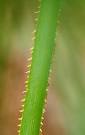
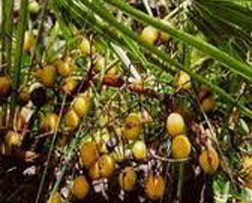
Saw Palmetto, whose botanical name is Serenoa Repens, is a small, low-growing, dwarf-palm tree native to Southeastern North America, particularly Florida. The Saw Palmetto plant produces berries, which when ripe each fall, are a bright orange to purple, almost black ovate, 3 cm long, 1 seeded berry, rich in fatty acids and phytosterols. Officially, Saw Palmetto's genus species/botanical name is Serenoa Repensand is in the Arecaceae (Palmae) family. Saw Palmetto is the common name, and other synonyms commonly used in other cultures include Sabal Serrulata, Serenoa Serrulata, Sabal Fructus, Sabal Baies du Chou Palmiste, Chou Palmiste, Bais du Palmier Scie, American Dwarf Palm Tree, Ju-Zhong, Palma Enana Americana, Palmier de Floride, Palmier Nain, Palmier Nain American, Palmier Scie. Many people also refer to saw palmetto as cabbage palm which is not correct. Cabbage Palmetto is sabal palmetto and grows to 80 feet tall.
Where does Saw Palmetto Grow?
Saw Palmetto is native to the very South Eastern part of the United States, mainly Florida. Saw Palmetto is also fairly abundant in the state of Georgia and there have been reports of saw palmetto growing in Alabama, Louisana, Mississippi, South Carolina, and Texas to a much lessor degree. Over 95% of all Saw Palmetto Harvested is done South of the Interstate 4 corridor that runs from Tampa to Orlando over to Daytona Beach in FLorida. Saw Palmetto does not grow in China or anywhere else in the world except in this very small area of the very Southeastern US. Floridata informationn Fact sheet Put photo of map where saw palmetto growns here.
How is Saw Palmetto Harvested and Processed?
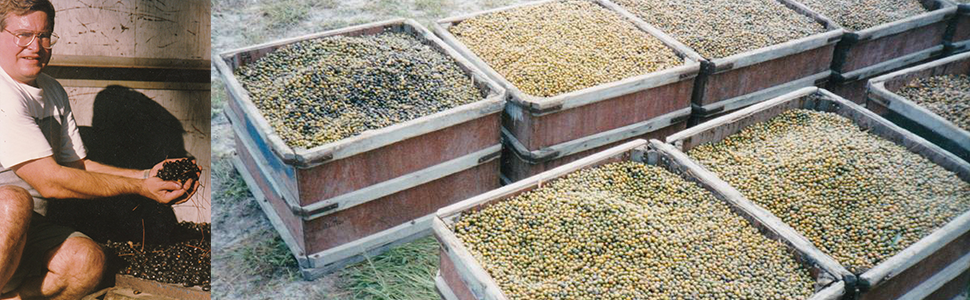
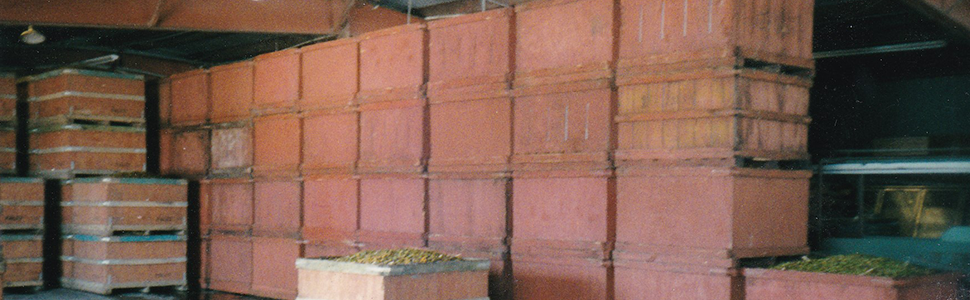
When the Saw Palmetto berries begin to ripen in late August in Southern Florida, and slowly moves Northward across the state, with the main harvest of ripe berries occuring in September. North of the I-4 Corridor, to the Gainesville, berries may not be ripe until October, and in Georgia not until November. Ripe Saw Palmetto berries will contain 10-15% fatty acids. August and September just happens to be in between vegetable crops and Citrus Fruit Crops in Florida and migrant workers are the main source of labor to manually pick the saw palmetto berries, as no machine exsists to pick the berries. The ripe Saw Palmetto berries are collected and bought to sites that purchase them by the pound from the pickers much as Lilly & Company did in the early 1900's. The Saw Palmetto berries are dried in dryers much like tobacco leaves are. In fact, some companies use tobacco dryers to dry the berries. Once the saw palmetto berries are dried to a moisture content of 5-6% moisture content, they are tumbled over a screen type system, with forced air blowing thru them to remove leaves, and unwanted trash. They can then be put into bags or containers and stored for further processing.
The dried Saw palmetto berries are then processed, and the first step is grinding the berries. If the manufacturer of dietary supplement needs powder for capsules or tablets, it is ground very fine, usually by means of a cyogenic grinder where the saw palmetto berries are frozen to a minus 200 degress fahrenheit or lower and run thru a hammer mill or pulveriser to a very fine powder. The powder can then be sterilized by various means.
If the manufacturer requires the liquid extract, the berries are crushed or ground into small particals to make the extraction process easier. Extraction can be done by using a alcohol solvent, or a super critical fluid such as hexane or carbon dioxide. Today, most saw palmetto extract is produced using super critical carbon dioxide. Carbon dioxide becomes a super critical fluid (air-liquid mixture) when compressed to 79 atm at 31C temperature. When the liquid Carbon Dioxide passes thru the chambers holding the crush saw palmetto berries, the fatty acids and phytosterols are extracted from the raw material and carried away with the liquified carbon dioxide. When the pressure of carbon dioxide is lowered to the point where it becomes a gas again in the holding tanks, the extract is left behind. The carbon dioxide gas is pumped thru the system again to be repressurized and makes the circle again and again. This extract is pure Saw Palmetto extract and then is sent to the lab for testing to ensure it meets various specifications, and total fatty acid content of between 85-95%. Rarely, would a batch not meet specifications unless the berries had been picked too green. It is for this reason, that only mature saw palmetto berries should be harvested.
How is Saw Palmetto Regulated in the US
Saw Palmetto is classified as a dietary supplement in the United States and falls under FDA regulations pursuant to the Dietary supplement Health and Education Act (DSHEA). The act restricts claims that Saw Palmetto can be used to treat, cure, or prevent any disease or condition, because only a drug can legally make such a claim. Nor, can one use clinical studies that suggest Saw Palmetto may aid in the treatment, cure, or prevention of a disease or condition. FDA regulates what claims can be made on a label, and advertising including web sites such as this one. The Federal Trade Commission (FTC) regulates advertising of Saw Palmetto and other dietary supplements in infomercials.
Counterfeit and Aldulterated Saw Palmetto Floods the US Market and Global Market
Saw Palmetto Extract is Expensive. It can only be harvested within a two week window when it is ripe, and a storm or lack of immigrant labor, can cause a dimished supply and drive prices up.
Like all expensive items; rolexes watches, Louis Vuittons or Kate Spades handbags, a stroll on Canal Street in New York City will have displays upon displays of counterfeit high end items. Saw Palmetto Extract is no different. While no Saw Palmetto grows in China, hundreds of Chinese firms advertise Saw Palmetto Extract at prices below what the cost of the raw materials to make Saw Palmetto Extract is, not to mention the cost of transporting Saw Palmetto to China and then back to the US.
So what is Counterfeit or Aldulterated Saw Palmetto?
Let's start with Aldulterated Saw Palmetto, because that is easier to explain. Saw Palmetto is composed of Fatty Acids and Sterols. Each of these fatty acids has a range of what percent is expected to be in Saw Palmetto. Likewise, the Sterols do to. Lets say the range for the fatty acid Lauric acid is 25-32% of the total fatty acids, and a particular lot comes in at 26%. Lauric Acids being a fairly cheap ingredient by itself could be added to bring the lauric acid content up to 32% and still be within the accepted range of Saw Palmetto. Likewise the sterol, beta sitosterol has an acceptable range of .1 - .4% content. If a batch came back at .1%, it could be made to look like superior grade Saw Palmetto Extract by fortiflying the beta Sitosterol content by adding just that ingredient say up to .3% and then charging for a superior product. Adulteration of this style is usually done at the supplier level. Luckily, tests have been devised to detect either of the above scenerios.
Counterfeit Saw Palmetto extract is not Saw Palmetto extract, but something that looks like it, smells like it, tastes like it and can pass for it. Usually, this is done by selling Palm Oil as Saw Palmetto Oil. Palm oil is primarily produced in Indonesia and Malaysia. Lookwise, it is slighly more red, because of it's high beta carotene content. It is inexpensive and is used aa a cooking oil and as a biofuel. Other Oils that sometimes passed off as counterfeit Saw Palmetto is Canola oil or coconut oil. It is estimated that over half, and perhaps up to 80% or more of the Saw Palmetto Extract being sold in China is counterfeit.
Lab and Analytical tests to confirm Saw Palmetto's authentic
The United States pharmacopia developed a testing procedure that if used accurately, can tell if a batch of Saw Palmetto Extract is alduterated or counterfeit. Basically the testing procedure takes the prcentage of Lauric acid and uses that as the root of the equation to determine what the percents of the other fatty acids should be. If they fall outside of acceptable range, it is because the product is adulterated or counterfeit. An example would be that the lauric acid content determined to be 26%. By using the usp chart, then the Palmitic Acid should be about 11%. If it came back at 30% or more, it is Palm Oil.
Comparision of Saw Palmetto Extract and Palm Oil
| Assay / fatty acids | Saw Palmetto |
|---|---|
| Caprylic Acid | 1.0-3.0% |
| Capric Acid | 1.0-3.0% |
| Lauric Acid | 25.0-32.0% |
| Myristic Acid | 10.0-15.0% |
| Palmitic Acid | 7.0-11.0% |
| Stearic Acid | 1.0-2.0% |
| Oleic Acid | 26.0-35% |
| cis-Linoleic Acid | 3.0-5.0% |
| Linolenic Acid | 0.5-1.5% |
| Fatty Acid Total | ≥ 85-95% |
| Assay / fatty acids | Palm Oil |
|---|---|
| Caprylic Acid | 0.06% |
| Capric Acid | 0.00% |
| Lauric Acid | 0.23% |
| Myristic Acid | 0.84% |
| Palmitic Acid | 36.76% |
| Stearic Acid | 0.00% |
| Oleic Acid | 49.48% |
| cis-Linoleic Acid | 11.74% |
| Linolenic Acid | 0.53% |
| Fatty Acid Total | ≥ 97-99% |
Sawpalmetto
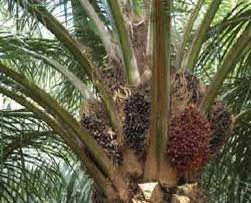
Palm Oil
Blacklist of Companies that sell Counterfeit Saw Palmetto Extract
The US Food and Drug Administration does nothing to stop the importation of counterfeit Saw palmetto Extract into the US. Instead they place the burden of detecting counterfeit ingredients upon the FDA registrant who must test ingredients to make sure their products do not contain aldulterated or counterfeit ingredients.
Chinese Companies that advertise Saw Palmetto Extract, are sometimes not even familar with Saw Palmetto Extract and make mistakes trying to market their counterfeit saw palmetto.
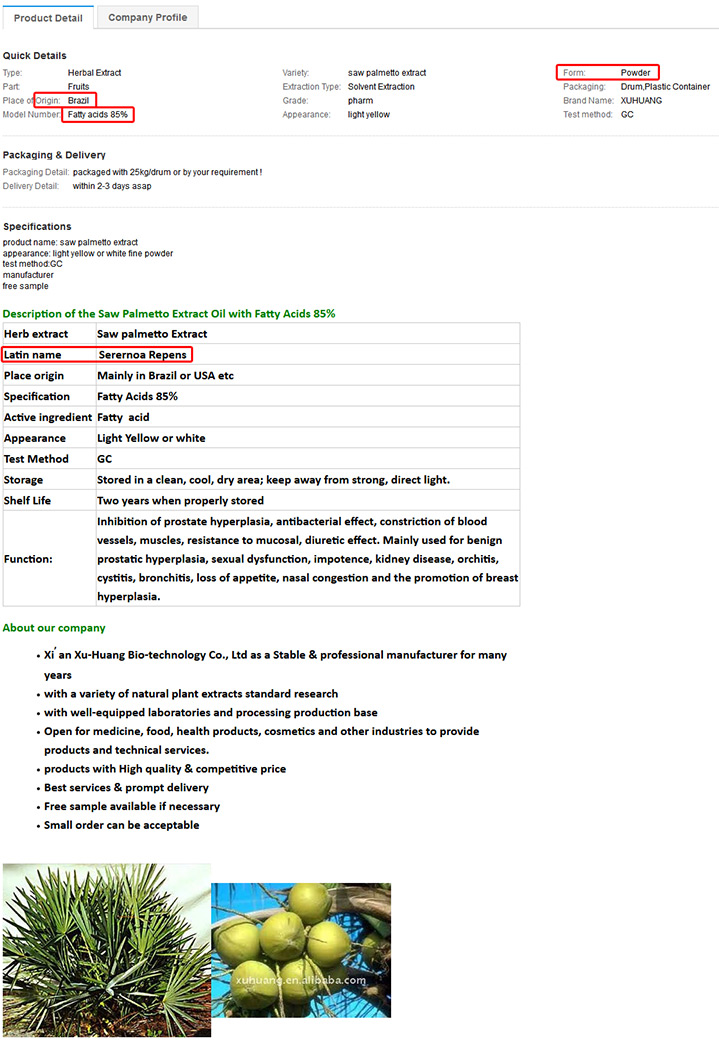
For example Xu-Huang Bio-technology Co., Ltd advertises that it has 85% extract that is a powder. 85% Saw Palmetto Extract is a liquid. Hu-Huang Bio Technology furthur advertises the place of origin as Brazil. Saw Palmetto does not grow in Brazil. An then the photo it shows to represent Saw Palmetto berries is actually coconuts, not Saw Palmetto. Further, it advertises that it can produce 10 tons a month. It would take 90 tons of dried Saw Palmetto Berries to produce 10 tons of extract.
Counterfeit Saw Palmetto Extract
Articles on Saw Palmetto
Information provided from: Jama
In a article published by the Journal of American Medical Association (JAMA) , it describes the uses of Saw Palmetto, and its effectiveness. After this article was published, two other studies came out that conflicted with these findings. It is not known what the circumstances where that caused these contradcitory findings, but theories exsist. To read the whole article click here.
Footnotes of quoted sources
sources are cited
Saw Palmetto Supplier of Raw Materials and Retail Products to Distributors and Manufacturers of Saw Palmetto and to the general public!